


Choose La Marzocco if…
You want the closest thing to genuine commercial cafe technology in a home footprint, and the saturated group's temperature stability matters more to you than anything else.


Buying Guides · Premium Espresso Machines
Once you're shopping in the premium home espresso tier, the question isn't really "which one makes good coffee" — at this level, all three genuinely do. The real differences are engineering philosophy, heritage, and the details that set each brand apart. Here's how La Marzocco, ECM, and Rocket actually differ.
La Marzocco, ECM, and Rocket sit at the point where home espresso equipment starts genuinely overlapping with commercial-grade components — dual boilers, PID temperature control, and build quality intended to last decades rather than years. Each brand has a distinct engineering identity though, shaped by where it's made and what it prioritises. Understanding those differences matters more at this tier than at the entry level, since you're choosing between three legitimately excellent options rather than trying to avoid a bad one.

La Marzocco's home range — including the GS3 — brings the same saturated group head design used in their full-size commercial machines into a residential footprint. This is a genuine, specific differentiator: rather than the E61 group common across most of the premium tier, La Marzocco's saturated group keeps the brewing chamber pre-heated by direct contact with the boiler, which the brand credits for exceptional shot-to-shot temperature stability.
La Marzocco Home models also offer mobile app connectivity on select machines for monitoring and scheduling — a modern touch alongside genuinely commercial internals. This is the brand most directly descended from actual cafe equipment, which shows in both performance and price.

ECM is hand-assembled in Heidelberg, Germany, and its flagship Synchronika uses a dual boiler with independent PID control and flow control capability, built around the E61 brew group — an Italian design shared across much of the wider espresso industry, but paired here with German build quality: rotary pumps and substantial copper boilers designed for long-term serviceability.
ECM's range spans from the more compact, entry-tier Classika heat exchanger through to the Synchronika, so there's meaningfully more price flexibility within the brand than the flagship alone suggests. Stainless steel construction with wood or chrome detailing gives it a distinct, understated aesthetic compared to the other two.
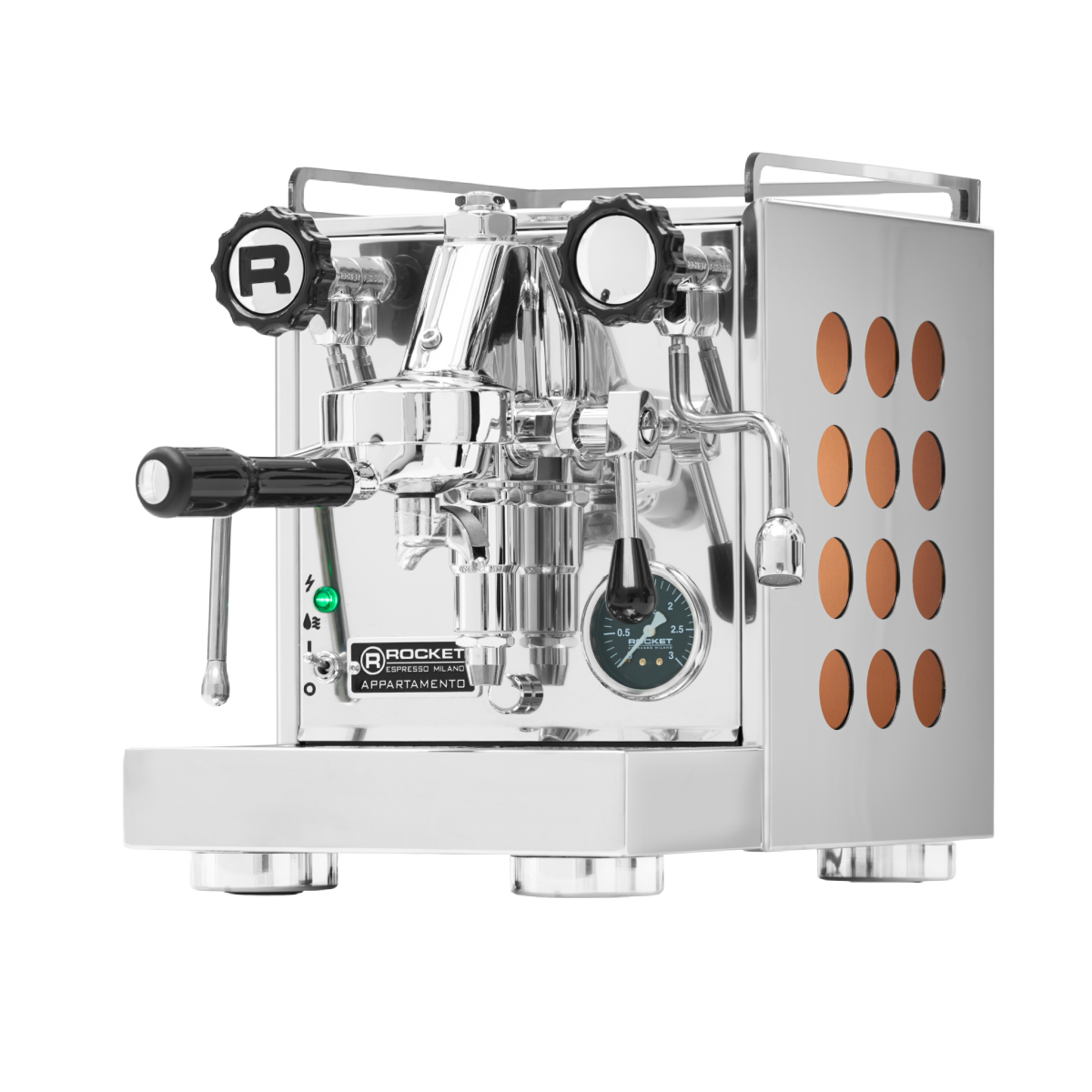
Rocket Espresso is hand-assembled in Milan, and the range leans harder into visual design than the other two — polished stainless steel bodies, an exposed E61 group, and a circular pressure gauge that's become something of a signature look. The Appartamento is the most accessible entry point into the brand, a compact heat exchanger machine built around the same E61 group used across most of the range.
At the top of the Rocket range, machines like the R9 One add flow control and pressure profiling — features that let you shape pressure through the shot rather than accepting a fixed curve, appealing to enthusiasts who want to experiment with extraction variables.
| Brand | Origin | Group type | Design character |
|---|---|---|---|
| La Marzocco | Florence, Italy | Saturated (proprietary) | Closest to genuine commercial cafe equipment |
| ECM | Heidelberg, Germany | E61 | Understated, precision-focused |
| Rocket | Milan, Italy | E61 | Bold, design-forward, kitchen centrepiece |
You want the closest thing to genuine commercial cafe technology in a home footprint, and the saturated group's temperature stability matters more to you than anything else.
You value understated German build quality and long-term serviceability, and want more entry points into the brand's range than just the flagship.
The machine is as much a kitchen centrepiece as a tool — Rocket's design language is the boldest of the three, without sacrificing genuine E61 performance.
All three are legitimate long-term investments. Talk to us about how you actually brew day to day — that usually narrows it down faster than specs alone.
Browse the full range from all three brands, or get in touch and we'll help you weigh up the differences.
Shop Premium Machines Contact UsA saturated group (used by La Marzocco) keeps the brewing chamber in constant direct contact with the boiler, which the brand says gives exceptional temperature stability. An E61 group — used by ECM, Rocket, and much of the wider industry — is a widely-proven Italian design that circulates hot water through the group via thermosiphon. Both are genuinely capable of excellent, stable espresso; they're different engineering approaches to the same goal.
It depends what you're optimising for. All three offer genuinely commercial-grade components — dual boilers, precise PID control, and build quality intended to last decades — which entry and mid-range machines typically don't match. If long-term durability, thermal stability, and resale value matter to you, the price gap reflects real engineering differences rather than just branding.
All three are well-supported and serviceable, but ECM in particular is built with long-term serviceability as a stated design priority, with widely available parts. Regardless of brand, dual boiler machines at this tier still need regular descaling and routine group/portafilter cleaning like any espresso machine.
Yes — none of these three brands include a grinder with their espresso machines. A quality burr grinder is a separate purchase, and it's worth budgeting for one that matches the machine's capability rather than treating it as an afterthought.